
UK bond fund ownership records move onto Ethereum and Solana accessible 24/7

A UK investment manager with over £286 billion ($377B) in assets under management is testing a sharper version of fund tokenization with BAGEY: public blockchains are being used as part of the record that says who owns a regulated UK fund.
That finally moves the tokenization debate into fund administration rather than distribution alone. A tokenized fund can still be a blockchain-shaped claim on a conventional product whose decisive ownership record sits elsewhere.
Baillie Gifford is presenting a stronger model, one where the on-chain record forms part of the legal ownership register itself.
In that version, the token becomes the means by which an investor’s holdings are recorded. The consequence is tangible: if regulated fund ownership can live natively on public chains, the change is in the fund administration stack, not in crypto market exposure.
Baillie Gifford’s digital assets material frames tokenization as an upgrade to ownership records, settlement, access, and client outcomes. The appeal is that records and processes can move differently when ownership is represented on shared rails.
The launch answers one narrow, tokenized-fund question with a qualified yes: regulated funds are moving toward legal infrastructure on public chains, rather than blockchain-wrapped versions of existing products.
The model still has to prove it can support secondary transfers, around-the-clock settlement, or collateral use outside a controlled primary-market setting.
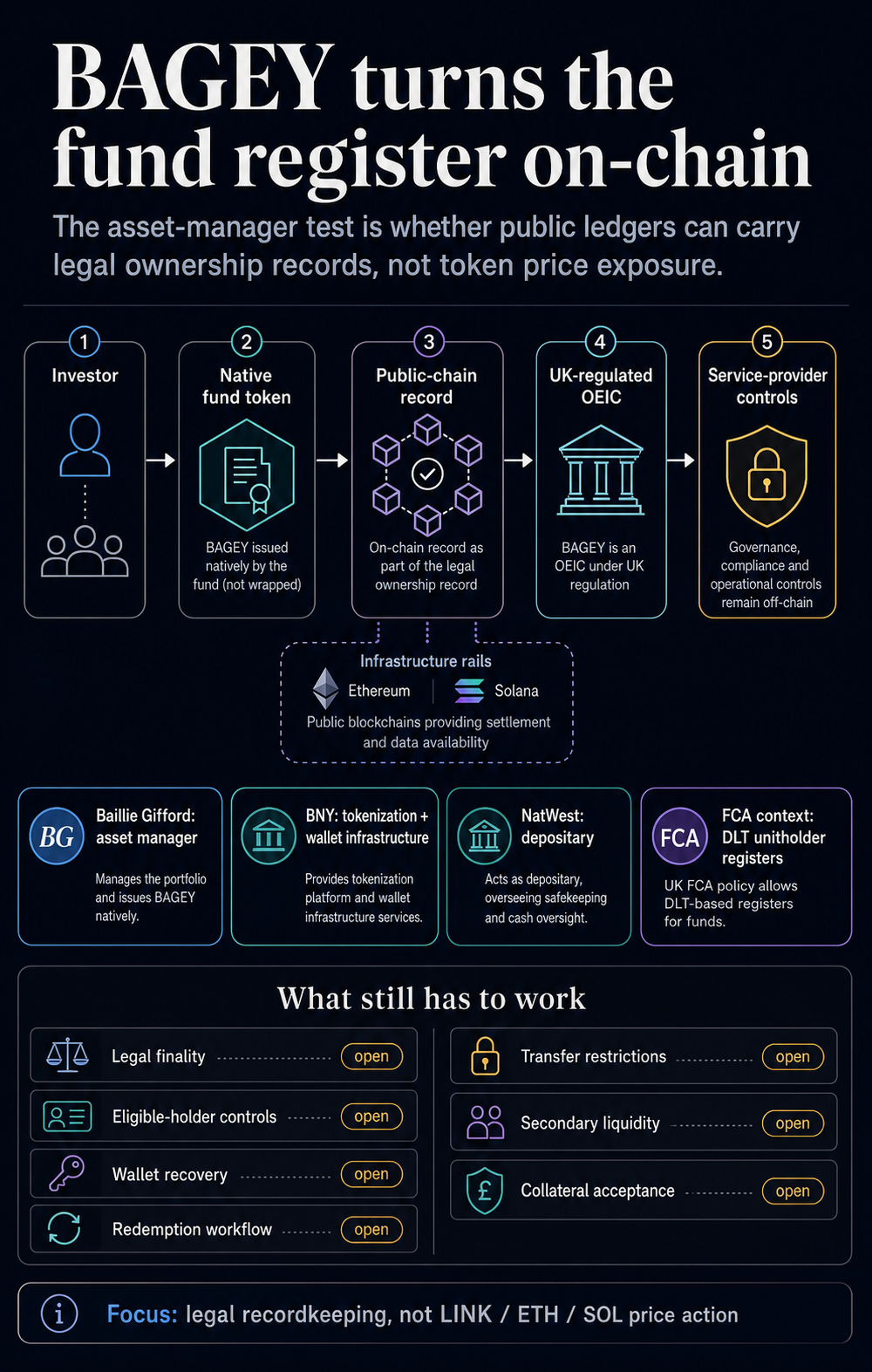
Native issuance shifts the ownership record through tokenization
The central claim around BAGEY is native issuance. Baillie Gifford described it as a fully native UK-regulated tokenized fund operating through a UK-regulated OEIC structure, with issuance on Ethereum and Solana, BNY providing tokenization and wallet infrastructure, and NatWest Trustee and Depositary Services acting as depositary.
If the blockchain is the legal register, then the fund administrator, custodian, transfer agent, depositary, and investor are coordinating around more than a private database that later reconciles with a token.
The shared ledger becomes part of the record that says who owns what.
That is materially different from a tokenized wrapper. A wrapper can give investors blockchain-based access to fund exposure while keeping the legally decisive register within traditional infrastructure.
It can still be useful, but the operational center of gravity stays off-chain. BAGEY’s more important claim is that the record layer itself has moved.
| Model | Where ownership lives | What the token does | Main question |
|---|---|---|---|
| Native tokenized fund | The on-chain record is presented as part of the fund ownership register | Records the investor’s direct holding in the regulated fund | Can legal, custody, transfer, and recovery controls hold up in production? |
| Tokenized wrapper | A separate fund or administrator record remains the decisive source | Represents access to an off-chain product | Does the wrapper add real utility beyond distribution? |
| Crypto exposure product | Traditional product records remain central | Gives exposure to a token, chain, or related strategy | How does the asset price perform? |
That distinction keeps LINK, ETH, and SOL price action secondary. Chainlink amplified the launch, and Ethereum and Solana provide the public-chain infrastructure, but the news centers on whether fund ownership can be recorded natively on shared public ledgers inside a regulated structure.
The UK backdrop turns tokenization into fund plumbing
The UK backdrop is central. The Financial Conduct Authority published PS26/7 on fund tokenization on April 30, setting out how authorized fund managers can use distributed ledger technology within the existing authorized fund framework.
The policy statement covers tokenized fund models and DLT-based unitholder registers, providing BAGEY with a regulatory framework beyond an isolated product launch.
CryptoSlate previously covered the UK’s move to approve tokenizing FCA-authorized investment funds. That earlier shift matters because BAGEY now backs the policy direction with a specific asset manager, fund structure, service-provider stack, and public-chain implementation.

It also follows tokenized-fund experiments in which Chainlink, Swift, UBS, and others tested subscriptions and redemptions, as well as transfer-agent automation. Those pilots demonstrated that traditional fund workflows could be integrated with blockchain systems.

BAGEY pushes the question further. The relevant issue is whether the record of regulated fund ownership can reside natively on public-chain infrastructure, rather than whether a single workflow can be automated.
For asset managers, that shifts the burden of proof. A tokenized fund wrapper can be evaluated based on access, distribution, and investor demand.
A native fund record must be assessed for legal finality, operational resilience, controls over eligible holders, failed or mistaken transfers, wallet loss, sanctions screening, redemption timing, and the point at which a blockchain entry becomes enforceable against the fund.

Those are practical back-office details. They determine whether the token can ever become useful beyond issuance and redemption.
A fund token that can be trusted as the legal ownership record could, in theory, move more easily between approved holders and settle outside conventional market hours because counterparties can see and rely on the ownership record. If those legal and operational controls remain limited, tokenization stays closer to a controlled distribution channel.
The same caution applies to collateral. Baillie Gifford’s broader tokenization materials discuss asset mobility and client outcomes, but BAGEY’s launch record alone does not establish that the fund token is already accepted as collateral across market venues.
That is why the next disclosures matter as much as the launch label: they will show whether the on-chain register changes daily fund operations or mainly changes how the product is issued.
The next test is operational proof
BAGEY shows that a large traditional asset manager is willing to put a regulated fund structure on public-chain rails and describes the result as native rather than wrapped. It also shows that major service providers can be brought into that structure.
BNY’s infrastructure role and NatWest’s depositary role matter because regulated funds do not become legal infrastructure solely through a smart contract. They need oversight, reconciliation, controls, custody procedures, and investor protections that institutions can defend.
The launch stops short of showing that tokenized fund units will trade freely around the clock, become widely accepted as collateral, or replace the rest of the fund administration stack. Those outcomes require evidence of actual transfer mechanics, secondary liquidity, investor onboarding, redemption performance, and legal treatment under stress.
That is the next test for tokenized funds. The industry already knows that financial products can be represented on blockchains.
The harder question is whether regulated institutions will treat public-chain records as the place where legal ownership is established, updated, and relied upon by other market participants.
If the answer becomes yes, tokenization stops being mostly a packaging story. It becomes a change to the plumbing behind fund ownership.
Asset managers would then compete not just on product exposure, but on how fast, transparent, portable, and operationally reliable their fund records are.
If the answer remains partial, BAGEY may still be important, but in a more limited way. It would show that native issuance can work inside a controlled environment while leaving the most consequential market functions, including peer-to-peer transfer and collateral use, for later.
For now, BAGEY moves the discussion forward without ending it. It is a live test of whether public blockchains can carry a regulated ownership record, rather than proof that they have already replaced the old fund administration stack.