CLARITY Act Odds Fall To 41% As White House Receives Letter Opposing Key Provisions
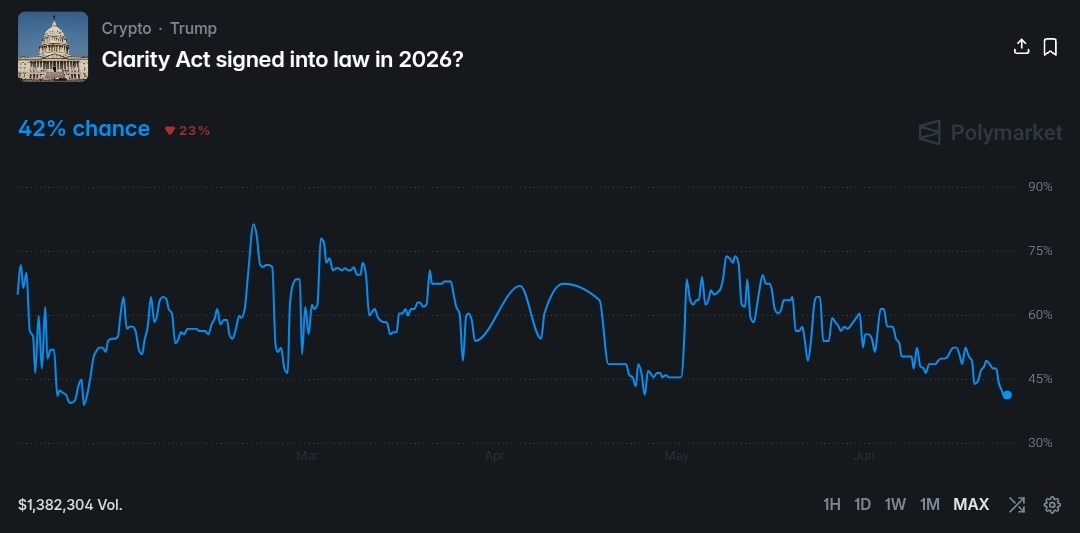
Within just a day, the odds of the CLARITY Act approval fell to 41%. The drop came when the White House got a letter from crucial U.S. law enforcement groups. They expressed their major concerns with provisions, which could make it difficult to regulate illicit practices in the crypto market.
Law Enforcement Groups Flag Concerns With CLARITY Act Provisions
The letter dated June 23 was sent to Acting Attorney General Todd Blanche and and Trump’s White House crypto advisor Patrick Witt. Signed by leaders of the National District Attorneys Association (NDAA), National Association of Assistant U.S. Attorneys (NAAUSA), International Association of Chiefs of Police (IACP) and the National Sheriffs’ Association. It represents over 70,000 law enforcement professionals.
The groups said they are in favor of a regulatory framework for digital assets. However, they noted that certain aspects of the CLARITY Act could undermine some aspects of the financial crime fight, including oversight and enforcement tools. For this, they spotlighted the Blockchain Regulatory Certainty Act (BRCA), which offers developer protections.
“Since concerns regarding Section 604 first emerged earlier this year, our organizations have engaged constructively with lawmakers, Administration officials, and stakeholders regarding its potential impact on public safety and criminal enforcement,” the letter states.
The organizations argued that the law enforcement community has “consistently expressed concern that broad exemptions could create gaps in oversight and accountability that sophisticated criminal actors may exploit.” The renewed scrutiny triggered a decline in the CLARITY Act passage odds from 55% to 41% on Polymarket within hours.
It states that digital assets are being used in various criminal activities such as fraud, ransomware attacks, sanctions violations, drug trafficking, child exploitation, money laundering and as part of organised retail crime. It cautions that the way in CLARITY Act Section 604 is written, it “risks creating gaps in oversight and accountability” for investigations and prosecutions.
Weak Clauses Around AML & Terrorism Funding
“Our concern is not with individuals who merely write or publish software code, nor with responsible technological innovation,” the organizations wrote. They added, “Rather, our concern is with broad exemptions that may shield individuals or entities whose activities facilitate the movement of digital assets.”
⬇️ You can read the full letter here: pic.twitter.com/7SlZHDN29r
— Eleanor Terrett (@EleanorTerrett) June 23, 2026
The groups also raised concerns that other provisions in the bill may decrease transparency and make weak points in the anti-money laundering and counter-terrorism financing systems. They highlighted, in particular, certain provisions that could exclude participants, such as mixers, tumblers and some decentralized finance (DeFi) enterprises, from the regulatory requirements.
The letter also said that “no class of market participant should receive a blanket exemption from registration, know-your-customer (KYC), Bank Secrecy Act (BSA), or AML/CFT requirements.” They say that regulatory clarity is not a cost that should be borne by a lack of accountability, transparency, victim protection or public safety.
For those looking for decentralized futures trading, visit our page on Perp DEXs.